



Hormuz Shipping Traffic Plunges to Just 7 Vessels as Maritime Security Fears Disrupt Global Energy Trade
Hormuz Shipping Traffic Plunges to Just 7 Vessels as Maritime Security Fears Disrupt Global Energy Trade
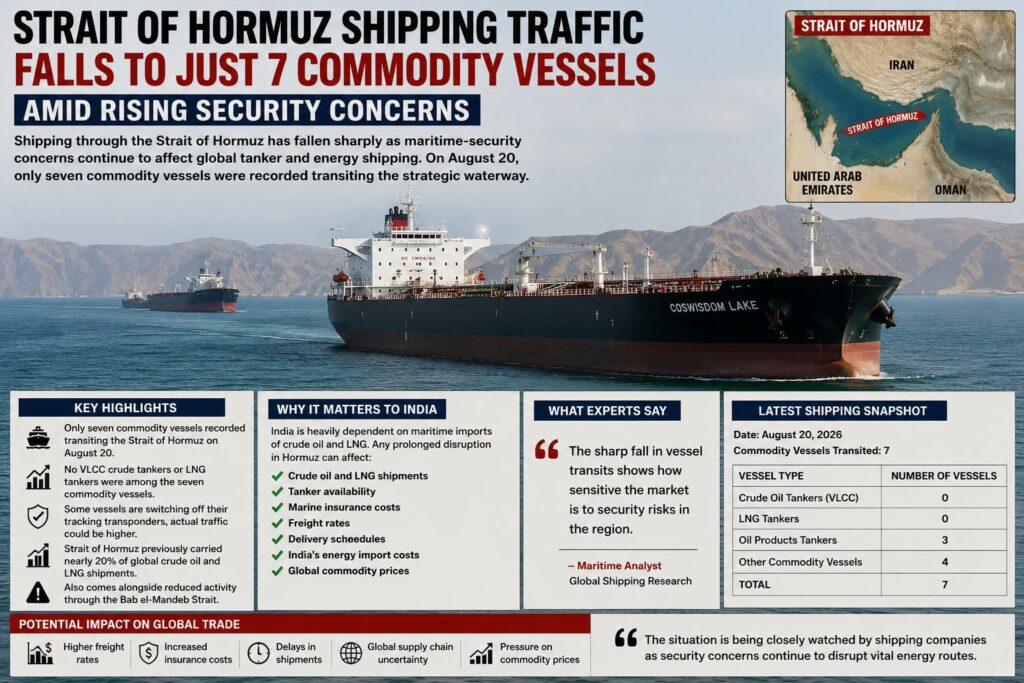
Shipping traffic through the Strait of Hormuz has fallen sharply amid growing maritime-security concerns, with only seven commodity vessels recorded transiting the strategic waterway on August 20, according to Kpler ship-tracking data.
The sharp decline highlights the growing risks facing one of the world’s most important maritime trade routes. The Strait of Hormuz is a critical gateway for global energy supplies, with around 20% of global crude-oil and LNG shipments historically passing through the waterway.
Sharp decline in vessel movements
The latest figures show an unusually low level of commercial shipping activity through Hormuz.
According to vessel-tracking data, only seven commodity vessels were recorded crossing the strait on August 20. Notably, no very large crude carriers (VLCCs) or LNG tankers were among those recorded vessels.
The decline comes as shipping companies increasingly assess the security risks associated with operating in the region.
Why the Strait of Hormuz matters
The Strait of Hormuz connects the Persian Gulf with the Gulf of Oman and the Arabian Sea.
It is one of the world’s most strategically important maritime chokepoints because major oil and gas exporters use the route to reach international markets.
Countries whose energy supplies depend heavily on shipments through the region include India, China, Japan, South Korea and several European markets.
Any prolonged disruption could therefore have consequences far beyond the Middle East.
Impact on global shipping
Lower vessel movements through Hormuz could create significant pressure across the shipping industry.
Potential effects include:
- Higher tanker freight rates
- Rising marine-insurance premiums
- Longer voyage routes
- Increased fuel consumption
- Delays in energy deliveries
- Higher crude-oil and LNG prices
- Greater uncertainty for ship operators
Shipping companies may also consider alternative routes where practical, although alternatives can involve substantially longer voyages and higher costs.
India faces particular exposure
India is one of the world’s major energy-importing countries and therefore closely watches developments around the Strait of Hormuz.
A sustained reduction in tanker traffic could affect India’s crude-oil and LNG supply chains.
Higher freight, insurance and energy costs could ultimately increase the landed cost of imported commodities and place additional pressure on industries that depend heavily on energy.
For India’s EXIM sector, the consequences could extend beyond petroleum products.
Higher energy and logistics costs can affect manufacturing, transportation, chemicals, plastics, engineering products and other export-oriented industries.
Tracking data may not show the complete picture
There is also an important limitation when interpreting vessel-tracking data.
Some ships operating in high-risk areas may switch off or restrict their automatic identification systems for security reasons.
As a result, the number of vessels actually moving through the waterway could be higher than the number visible through commercial tracking systems.
Nevertheless, the exceptionally low recorded traffic highlights the level of caution currently being exercised by shipping operators.
Bab el-Mandeb also under pressure
The situation around Hormuz is occurring alongside continuing concerns over another major maritime chokepoint — the Bab el-Mandeb Strait.
The route is important for vessels travelling between the Indian Ocean and the Red Sea and is closely connected to the wider Asia-Europe shipping network.
Disruptions at multiple maritime chokepoints can put additional pressure on global supply chains and encourage shipping companies to reconsider voyage planning.
What shipping companies are watching
Shipowners, charterers and cargo operators are closely monitoring several factors:
Security: Whether vessels can safely transit the region.
Insurance: Whether war-risk and other marine-insurance premiums increase.
Freight rates: Whether reduced vessel availability pushes tanker rates higher.
Alternative routes: Whether rerouting becomes commercially viable.
Energy prices: Whether supply concerns increase global crude-oil and LNG prices.
Port operations: Whether disruptions create congestion at alternative gateways.
What it means for India’s EXIM trade
The developments demonstrate how quickly geopolitical and security risks can affect maritime trade.
For Indian exporters and importers, disruptions to major shipping routes can translate into higher transportation costs, longer delivery times and greater uncertainty over cargo schedules.
Companies involved in international trade may therefore need to closely monitor freight rates, fuel prices, insurance costs and vessel schedules.
A critical maritime chokepoint under watch
The Strait of Hormuz remains one of the most important arteries of global energy trade.
The sharp fall in recorded vessel movements is therefore a significant development for the international shipping industry.
Whether the decline proves temporary or develops into a prolonged disruption will depend heavily on the security situation and the willingness of commercial shipping operators to resume normal transits.
For India and the wider global EXIM community, the key concern is clear: any prolonged disruption at Hormuz could increase the cost and complexity of moving energy and goods around the world.
EXIM India Times | Vessel & Maritime News
About The Author