











Free Trade Agreements Boost Import-Export Activity
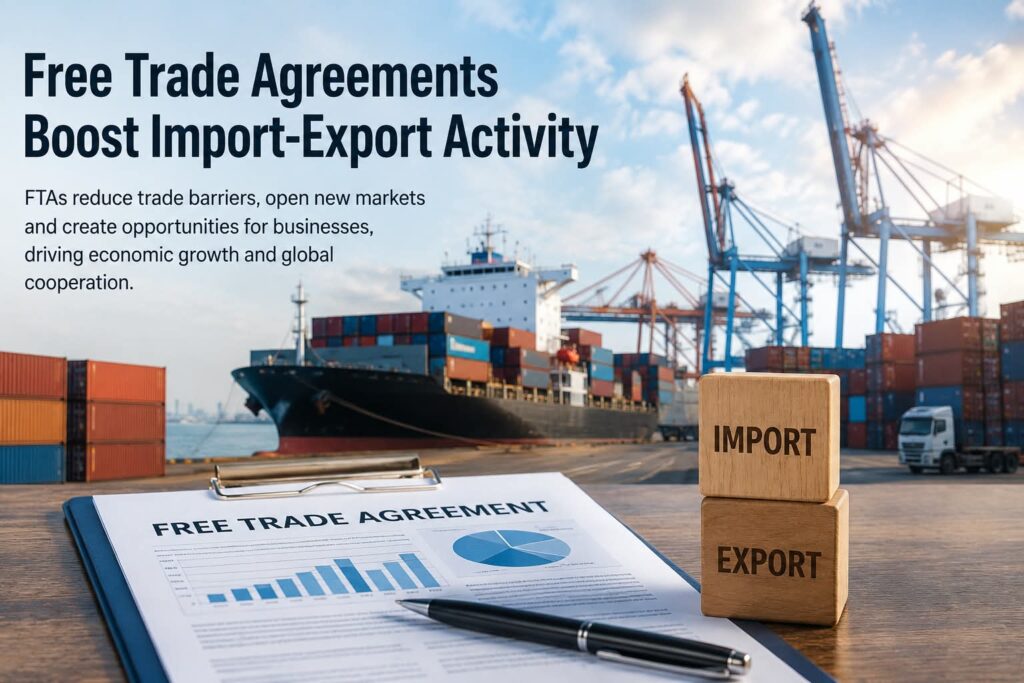
India’s expanding network of Free Trade Agreements (FTAs) is creating new opportunities for exporters and strengthening the country’s import-export activity, as businesses gain improved access to international markets and benefit from lower or preferential tariffs.
The latest developments come as India deepens trade relationships with major economies and trading blocs, including the United Arab Emirates, Australia, the United Kingdom, the European Free Trade Association (EFTA), the European Union and New Zealand. Government data shows that India’s combined merchandise and services exports reached a record US$863.1 billion in FY 2025–26, with merchandise exports at US$441.8 billion and services exports at US$421.3 billion.
FTA Markets Account for a Major Share of Exports
FTA partner countries accounted for about 40.5% of India’s merchandise exports in FY 2025–26, with shipments to these markets reaching approximately US$179.1 billion. The growing share demonstrates the increasing importance of preferential trade arrangements for Indian exporters.
The agreements are designed to reduce tariffs and other trade barriers while improving market access for Indian products. They can also help businesses diversify their export destinations and become more competitive internationally.
UK Trade Agreement Opens New Opportunities
India’s Comprehensive Economic and Trade Agreement (CETA) with the United Kingdom entered into force on July 15, 2026, creating new opportunities for Indian exporters in the UK market.
The agreement is particularly important for labour-intensive sectors and manufacturing industries. Businesses in textiles, apparel, leather, footwear, engineering products, pharmaceuticals, chemicals and other sectors can benefit from improved market access.
The agreement is also expected to strengthen India’s position in the UK market at a time when exporters are looking for greater diversification and more predictable trading conditions.
Australia Provides Zero-Duty Access
The India-Australia Economic Cooperation and Trade Agreement (ECTA) has already demonstrated significant trade benefits.
India’s exports to Australia increased from approximately US$4 billion in FY 2020–21 to US$8.5 billion in FY 2024–25, while bilateral trade reached US$24.1 billion during FY 2024–25.
From January 1, 2026, all Indian exports became eligible for zero-duty market access in Australia under the agreement. Growth has been recorded across sectors including textiles, pharmaceuticals, chemicals and agricultural products.
UAE Agreement Supports Export Growth
India’s Comprehensive Economic Partnership Agreement (CEPA) with the UAE has also expanded opportunities for Indian companies.
India secured duty-free or preferential access on 97% of UAE tariff lines covering 99% of India’s exports, with immediate duty elimination on more than 80% of tariff lines.
An analysis of India’s trade performance found that product categories showing stronger post-FTA growth in the UAE increased from about US$7.29 billion in 2022 to US$16.56 billion in 2025, demonstrating the potential impact of improved market access.
New Zealand Agreement Expands Market Access
India and New Zealand signed a Free Trade Agreement on April 27, 2026. The agreement provides for full duty-free access for Indian exports to New Zealand once it enters into force, while India will progressively liberalise tariffs on a significant portion of imports.
The agreement is expected to benefit sectors such as textiles, apparel, leather, footwear, engineering products and processed foods, while also establishing a framework aimed at encouraging investment.
European Union Deal Could Transform Trade
India and the European Union concluded negotiations for a major FTA in January 2026. The agreement is expected to provide preferential market access across a wide range of goods and services once it enters into force.
According to India’s Commerce Ministry, the agreement provides preferential access covering 96.8% of tariff lines and 99.5% of India’s exports to the EU, while 90.7% of exports by trade value are expected to become duty-free upon entry into force.
Labour-intensive industries such as apparel, textiles, leather, footwear, gems and jewellery are among the sectors expected to benefit significantly.
EFTA Agreement Strengthens European Trade Links
India’s Trade and Economic Partnership Agreement (TEPA) with the European Free Trade Association — comprising Iceland, Liechtenstein, Norway and Switzerland — entered into force in October 2025.
The agreement offers preferential access to Indian exporters while creating a broader framework for investment, services and technology cooperation. EFTA has offered concessions covering a large majority of India’s exports, while the agreement includes a commitment involving up to US$100 billion in investment over 15 years.
However, the early trade results also show that FTAs do not automatically increase exports across every product category. Recent data showed India’s non-gold exports to EFTA remained almost unchanged year-on-year in April–June 2026, highlighting the importance of businesses actually using the tariff concessions and meeting market requirements.
Exporters Increasingly Benefit From FTA Concessions
Recent Commerce Ministry data indicates that utilisation of India’s trade agreements is increasing. In the first quarter of FY 2026–27, exports under FTAs to some partner markets recorded strong growth, with shipments to Singapore and Sri Lanka more than doubling compared with the corresponding period.
This trend suggests that exporters are becoming more familiar with rules of origin, certificates of origin and other requirements needed to claim preferential tariff benefits.
Benefits for MSMEs and Labour-Intensive Industries
Small and medium-sized businesses are among the potential beneficiaries of India’s expanding trade network.
Lower tariffs can make Indian products more competitive overseas, while improved market access can allow companies to expand beyond traditional destinations. Industries such as textiles, footwear, leather, engineering, pharmaceuticals, food processing, marine products and gems and jewellery are expected to see opportunities across different agreements.
FTAs can also encourage Indian companies to increase production capacity, improve quality standards and integrate more deeply into international supply chains.
Importers Could Also Gain
While FTAs are often discussed from an export perspective, importers can also benefit from lower duties on selected goods and raw materials.
Access to competitively priced raw materials, machinery, chemicals, metals and other industrial inputs can reduce production costs for Indian manufacturers. The India-Australia agreement, for example, has improved access to products such as base metals, raw cotton, chemicals, fertilisers and pulses.
However, India continues to maintain safeguards and exclusions for sensitive sectors where increased imports could affect domestic producers.
Challenges Remain
Despite the growing number of agreements, businesses still face challenges in converting preferential access into actual trade growth.
Exporters must comply with rules of origin, product standards, documentation requirements and other regulations in destination markets. Non-tariff barriers can also reduce the practical benefits of tariff concessions.
Indian exporters are additionally preparing for new environmental requirements in major markets. The EU’s Carbon Border Adjustment Mechanism remains an important concern, particularly for businesses exporting carbon-intensive products. India and the EU have included a work plan addressing CBAM-related concerns as part of their broader trade framework.
Outlook
India’s expanding FTA network is becoming an increasingly important part of the country’s export strategy. With major agreements involving the UK, Australia, UAE, EFTA and New Zealand and the India-EU agreement moving toward implementation, Indian companies have access to a growing number of preferential markets.
The government is also continuing trade negotiations with other economies and regional groups, while working to diversify India’s export destinations.
The next stage will depend not only on signing agreements but also on how effectively Indian businesses use them. Better awareness among exporters, faster customs processes, compliance support and stronger domestic manufacturing capabilities could help convert preferential market access into sustained export growth.
Conclusion
Free Trade Agreements are reshaping India’s international trade landscape by reducing tariffs, opening new markets and creating opportunities for exporters and importers. With India’s exports reaching a record US$863.1 billion in FY 2025–26, the expanding network of trade agreements could play an important role in the country’s ambition to strengthen its position in global commerce.
For Indian businesses, the opportunity is increasingly clear: understanding and effectively using FTA benefits could become a major competitive advantage in the global market.
About The Author