









Shipping Companies Invest Billions in Green Fuel Transition
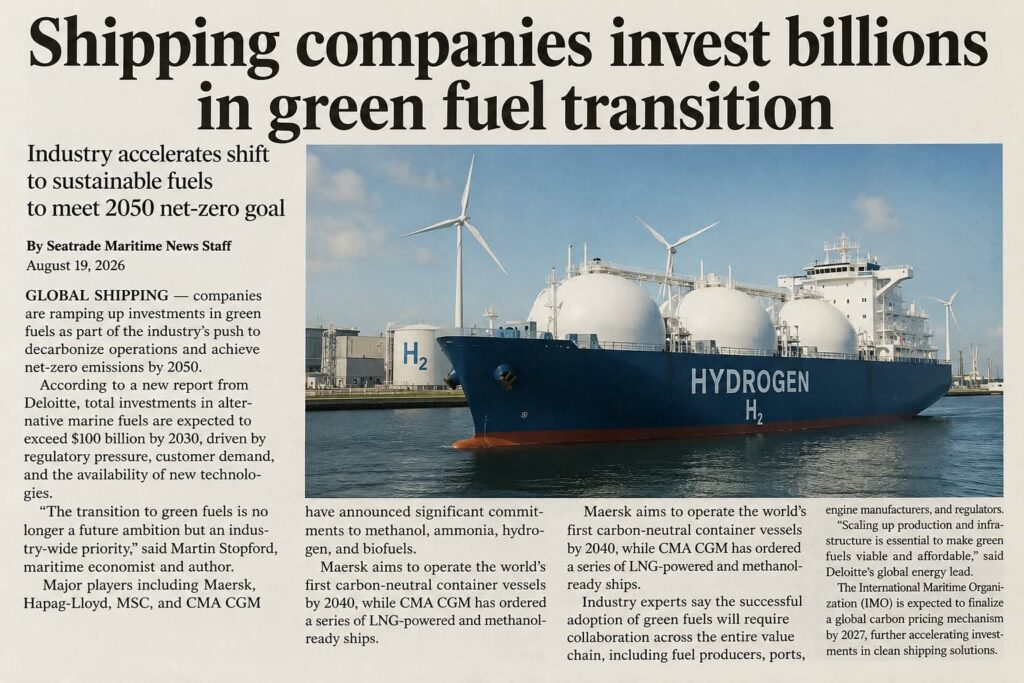
Shipping Companies Invest Billions in Green Fuel Transition
Global Shipping Industry Accelerates Shift Toward Lower-Emission Fuels
The global shipping industry is stepping up investments in alternative fuels and cleaner vessel technologies as companies prepare for tighter environmental regulations and the long-term goal of reaching net-zero greenhouse-gas emissions around 2050.
Major shipping companies are exploring a range of options, including green methanol, biofuels, biomethane, ammonia, hydrogen and other low- and near-zero-emission technologies. The transition is expected to require major investments not only in ships, but also in fuel production, storage, bunkering infrastructure and port facilities.
Regulation Is Driving the Transition
The International Maritime Organization (IMO) has been developing a global framework that combines a marine-fuel standard with an emissions-pricing mechanism. The framework is designed to progressively reduce the greenhouse-gas intensity of marine fuels and create financial incentives for ships using zero- or near-zero-emission technologies. �
International Maritime Organization +1
However, the IMO’s adoption process was postponed in October 2025, with negotiations scheduled to resume in 2026. This means the regulatory environment remains an important factor for shipping companies making long-term investment decisions. �
International Maritime Organization
Methanol Emerges as a Major Option
Green and e-methanol have become important parts of the industry’s transition strategy. Methanol can be used in specially designed dual-fuel engines and is already being adopted in commercial shipping.
Maersk says it is exploring several alternative fuel pathways, including biofuels, bio- and e-methanol and biomethane. The company is already operating vessels capable of using methanol-based fuels. �
Maersk
Methanol is attractive because it can be handled using established liquid-fuel infrastructure more easily than some emerging alternatives. However, the availability and price of genuinely low-emission methanol remain significant challenges.
Biofuels Provide an Immediate Option
While the industry develops next-generation fuels, biofuels are providing a solution that can be introduced more quickly.
Hapag-Lloyd and Kuehne+Nagel, for example, agreed on a 2026 sustainable-marine-fuel programme using certified waste- and residue-based biofuels. The agreement covers approximately 3,300 TEU of cargo and is expected to avoid around 2,979 tonnes of CO₂-equivalent emissions on a well-to-wake basis. �
Hapag-Lloyd
Ammonia and Hydrogen Remain Long-Term Options
Ammonia and hydrogen are also being investigated as potential future marine fuels, particularly for vessels where battery-electric propulsion is impractical because of the enormous energy requirements of long-distance ocean voyages.
The IMO’s alternative-fuel work currently covers technologies and regulatory considerations for fuels including methanol, ethanol, ammonia and hydrogen. �
GreenVoyage2050
However, significant challenges remain. Green ammonia and green hydrogen require large amounts of renewable electricity for production, while storage, transportation, bunkering infrastructure and safety standards must be developed at scale.
Investment Extends Beyond Ships
The green-fuel transition is not simply a matter of replacing conventional engines.
Shipping companies and energy producers must build an entire ecosystem around alternative fuels, including:
Green-fuel production facilities
Renewable-energy projects
Fuel storage terminals
Bunkering infrastructure
New dual-fuel vessels
Engine and propulsion technology
Fuel-certification systems
Port infrastructure
Safety and training systems
India is also developing infrastructure for alternative marine fuels. In January 2026, Assam Petro-Chemicals signed an agreement with Deendayal Port Authority for a 150-tonnes-per-day e-methanol plant at Kandla, involving a reported capital investment of ₹1,200 crore. �
Press Information Bureau
Kandla has also been advancing methanol bunkering capabilities as part of India’s maritime decarbonisation efforts. �
Press Information Bureau
The Economics Remain a Major Challenge
The transition is expensive because green fuels are generally more costly and less widely available than conventional marine fuels.
Shipping companies therefore face a difficult balance: they need to invest early enough to meet future environmental requirements while avoiding excessive costs from technologies whose fuel supply chains are still developing.
Industry adoption is also being influenced by cargo owners. Companies increasingly want to reduce emissions from their supply chains, creating demand for lower-carbon shipping services.
At the same time, uncertainty around fuel availability, infrastructure and global regulation means the industry is pursuing several technologies rather than committing entirely to a single fuel.
A Multi-Fuel Future
The emerging picture suggests that shipping is unlikely to rely on one universal replacement for conventional fuel.
Instead, different technologies may serve different vessel types and routes:
Biofuels can provide relatively immediate emissions reductions, while methanol is already being deployed on commercial vessels. Ammonia and hydrogen could become more important as production, safety standards and bunkering infrastructure mature.
The IMO’s framework is intended to encourage this transition by progressively reducing allowable greenhouse-gas fuel intensity and creating economic incentives for cleaner ships. �
International Maritime Organization
Outlook
The shipping industry’s green-fuel transition is becoming a major investment theme across the maritime and energy sectors. Billions of dollars are expected to flow into alternative-fuel vessels, production facilities and supporting infrastructure as companies prepare for a lower-carbon future.
But the transition will not happen overnight. Fuel availability, cost, port infrastructure, technology maturity and international regulation will determine how quickly cleaner fuels become commercially competitive.
For shipping companies, the strategy is increasingly clear: invest in flexible vessels and fuel options today while preparing for a maritime industry where emissions performance will become an increasingly important part of operating costs and competitiveness.
The race toward greener shipping has begun—but the industry’s biggest challenge will be turning ambitious fuel-transition plans into a reliable, affordable global supply chain.
About The Author