










Red Sea Crisis Continues to Impact Global Shipping Routes
August 20, 2026
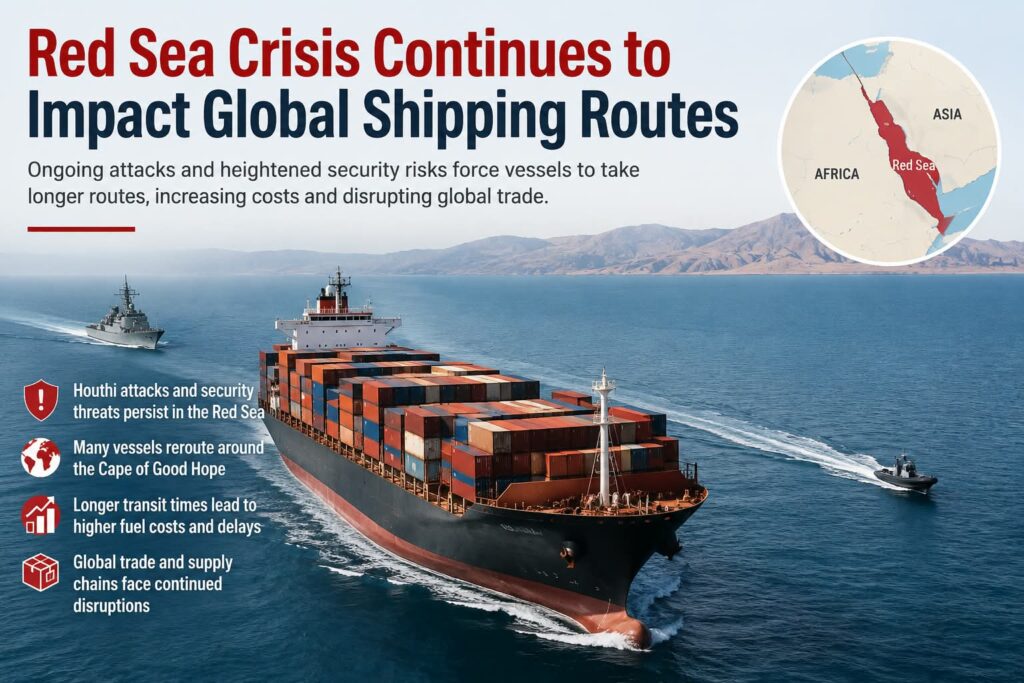
Ongoing geopolitical tensions in and around the Red Sea are continuing to reshape global shipping routes, creating uncertainty for carriers, cargo owners and international supply chains. Security concerns around the Bab el-Mandeb Strait have encouraged some vessels to avoid the traditional Red Sea–Suez Canal corridor and take the much longer route around the Cape of Good Hope in southern Africa.
The disruption is increasing voyage distances, fuel consumption, insurance costs and transit times, adding pressure to an already volatile global freight market.
Shipping Routes Under Renewed Pressure
The Red Sea is one of the world’s most important maritime corridors, linking the Indian Ocean with the Mediterranean through the Bab el-Mandeb Strait and the Suez Canal. The route normally provides a significantly shorter connection between Asia, Europe and parts of the Middle East.
However, renewed security threats in the region have changed the risk calculations for shipping companies. Recent attacks and threats involving commercial vessels have prompted some operators to maintain or reinstate diversions around Africa.
Lloyd’s List Intelligence reported that traffic through the Bab el-Mandeb has weakened in several vessel segments, while the security threat remains substantial. At the same time, some major container carriers have begun cautiously restoring selected services through the Suez Canal.
Cape of Good Hope Route Adds Time and Cost
Ships travelling between Asia and Europe through the Cape of Good Hope must sail considerably farther than vessels using the Suez Canal.
The additional distance can translate into longer voyages, higher bunker-fuel consumption, increased vessel operating costs and reduced effective shipping capacity. Industry estimates have previously indicated that rerouting around Africa can add roughly 10 days to some Asia-Europe journeys, depending on the service and port rotation.
For cargo owners, longer transit times can also mean higher inventory and working-capital costs, particularly when shipments involve time-sensitive goods.
Shipping Lines Take Different Approaches
The current situation is not a complete return to Cape of Good Hope routing. Shipping companies are taking different approaches based on their assessment of security risks.
Maersk and Hapag-Lloyd, for example, announced in August that their AE19/SE4 service would return to the Red Sea and Suez Canal instead of using the Cape of Good Hope. The carriers said the decision followed a careful assessment of the security environment and would provide a more direct and faster connection between Asia and Europe.
This follows earlier Gemini service changes in which selected services were also moved back toward the Suez route. However, the companies continue to monitor the security situation closely, meaning future routing decisions could change if conditions deteriorate.
At the same time, other vessels continue to avoid exposed areas. Recent vessel movements show that some Saudi-linked oil tankers have taken the longer Cape of Good Hope route rather than passing through the Bab el-Mandeb Strait.
Freight and Insurance Costs Remain a Concern
Longer routes are affecting more than transit schedules. Shipping companies face higher fuel consumption, crew costs, vessel utilization pressures and insurance premiums when operating in or near high-risk maritime zones.
War-risk insurance has become an important consideration for shipowners deciding whether to enter the Red Sea. Continued uncertainty can also encourage carriers to introduce additional surcharges to compensate for higher operational and security expenses.
The broader Middle East shipping disruption has already contributed to significant increases in freight and energy-related shipping costs.
Impact on Global Supply Chains
The consequences extend well beyond the shipping industry.
Longer voyages can affect the delivery schedules of consumer goods, machinery, electronics, raw materials, automobiles, energy products and other commodities. Importers may have to maintain larger inventories to protect themselves against unpredictable arrival times.
For exporters, higher freight and insurance costs can reduce profit margins and make products less competitive in international markets.
India is particularly exposed because a large share of its trade with Europe, the United Kingdom, North Africa and the eastern coast of the United States depends on maritime routes connected to the Red Sea and Suez Canal.
A recent assessment by the Global Trade Research Initiative said the prolonged Red Sea crisis has increased freight, insurance and working-capital costs for Indian exporters, particularly smaller businesses.
Oil and Energy Shipments Face Additional Risks
The Red Sea situation is occurring alongside disruption around another major maritime chokepoint — the Strait of Hormuz.
Recent reports indicate that shipping activity through Hormuz has slowed significantly amid continuing uncertainty. Reuters reported that only a small number of commodity vessels passed through the strait on August 18, while major Chinese shipping companies have also reduced operations through both Hormuz and Bab al-Mandeb.
The simultaneous pressure on multiple maritime chokepoints increases the potential for higher energy transportation costs and further supply-chain disruption.
China Looks Toward Alternative Routes
The continuing uncertainty is also encouraging shipping companies and governments to examine alternative trade corridors.
China has recently begun a regular cargo service through the Arctic’s Northern Sea Route, connecting Asia and Europe through a route that can be substantially shorter than sailing around the Cape of Good Hope. However, the Arctic route remains highly seasonal and faces challenges involving ice conditions, insurance, infrastructure and geopolitics.
This development highlights how geopolitical instability is encouraging the shipping industry to reconsider traditional global trade routes.
What Happens Next?
The future of Red Sea shipping will largely depend on maritime security conditions around Yemen and the Bab el-Mandeb Strait.
If security improves and carriers regain confidence, more services could gradually return to the Suez Canal. This would shorten transit times and improve vessel utilization.
However, if attacks or threats against commercial shipping intensify, carriers could again move more vessels toward the Cape of Good Hope, putting additional pressure on freight capacity and shipping costs.
For now, the industry is operating in a mixed-routing environment, with some major services returning to Suez while other vessels continue to avoid the Red Sea based on security assessments. The situation remains fluid, and shipping schedules can change rapidly.
Global Shipping Outlook
The Red Sea crisis demonstrates how geopolitical instability can quickly affect global trade. Even when the Suez Canal itself remains operational, security concerns around the approaches to the canal can influence whether commercial operators are willing to use the route.
For shipping companies, the priority remains balancing transit efficiency, cost, cargo schedules and crew safety. For importers and exporters, the continuing uncertainty means careful planning, flexible logistics arrangements and close monitoring of freight rates will remain essential.
As global trade continues to depend heavily on a small number of strategic maritime chokepoints, the Red Sea crisis is likely to remain an important factor influencing shipping routes, freight markets and international supply chains in the months ahead.
About The Author